AI Redlining: Ultimate Guide to Contract Negotiation
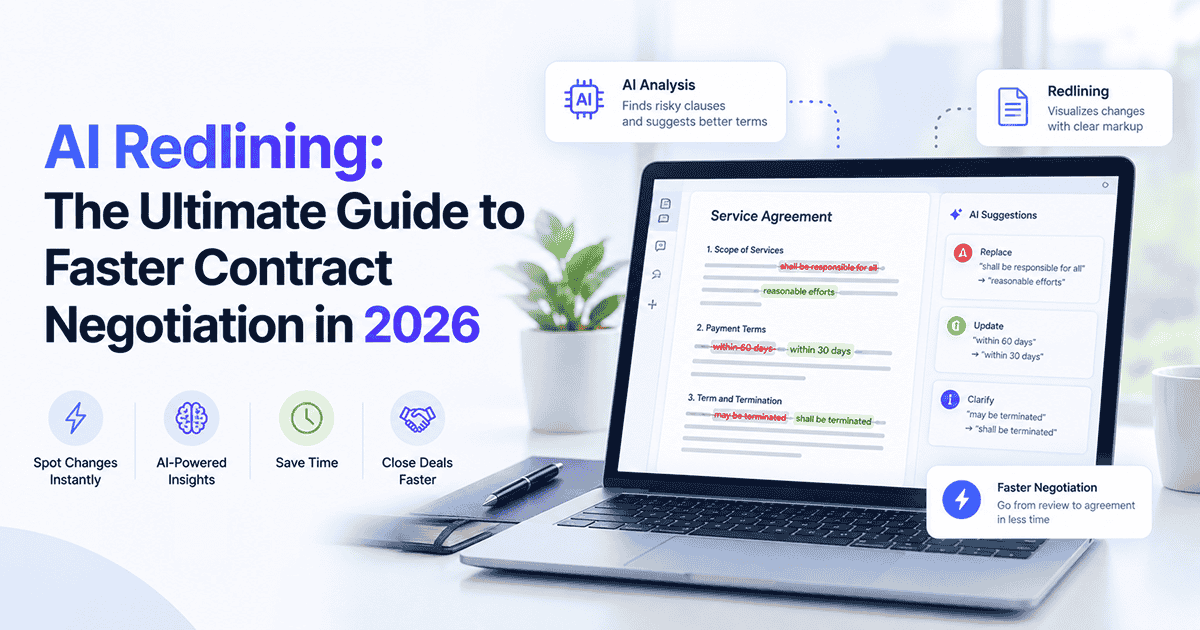
AI Redlining: The Ultimate Guide to Faster Contract Negotiation in 2026
You found the risky clause. Your AI risk scanner flagged the uncapped liability, your clause detector pulled up the termination terms, your summary told you exactly where the landmines are. Great — now what? This is exactly where AI redlining comes in, and it's the missing piece most "AI contract review" tools quietly leave out.
Most tools will tell you what's wrong with a contract all day long. Very few of them will actually help you fix it. That gap — between spotting a risk and negotiating it away — is exactly what AI redlining closes.
Let's break down what AI redlining actually is, how it fits into the rest of your contract workflow, and how to use it without losing control of your own negotiation.
What Is AI Redlining?
AI redlining is the use of artificial intelligence to suggest, draft, and track proposed edits to a contract — the same markup a lawyer would do by hand with tracked changes, except generated automatically against your own playbook.
Instead of a reviewer reading a 40-page MSA line by line and manually rewriting the indemnification clause, an AI redlining tool:
- Compares every clause against your standard position (your "playbook")
- Flags where the other side's language deviates from that standard
- Drafts a suggested replacement clause in the same legal tone as the rest of the document
- Explains, in plain English, why the change matters and what you're trading off
Think of it as the difference between a smoke detector and a fire extinguisher. Risk detection tells you something's burning. AI redlining hands you the tool to put it out.
How Does AI Redlining Work?
Most AI redlining tools, including the one built into Indigo eSign, follow a similar four-step loop.
Step 1: Ingest and Parse the Contract
The document is broken down into individual clauses — payment terms, liability caps, termination rights, IP ownership, confidentiality — so each one can be evaluated on its own instead of reading the whole agreement top to bottom.
Step 2: Compare Against Your Playbook
Your standard positions (say, "liability capped at 12 months' fees" or "60-day termination notice") act as the benchmark. Anything the counterparty's draft deviates from gets flagged for review.
Step 3: Generate the Redline
The AI drafts an alternative version of the clause — not a generic template, but language that matches the tone, structure, and defined terms already used in that specific contract.
Step 4: Explain the Trade-Off
A good redlining tool doesn't just change the words. It tells you why: "Uncapped liability exposes you to unlimited indirect damages. Suggested cap: 12 months of fees paid, consistent with your standard MSA position."
You stay the decision-maker the whole way through. The AI drafts the option — you accept, edit, or reject it.
Why AI Redlining Matters for Businesses
Manual redlining is one of the slowest parts of any contract cycle. A single vendor agreement can bounce between legal, procurement, and the counterparty five or six times before both sides agree on final language — and each round can eat a full business day.
AI redlining changes the math in a few concrete ways:
- Speed. First-pass redlines that used to take hours of attorney time now take seconds, freeing legal teams to focus on genuinely novel issues instead of routine clauses.
- Consistency. Every contract gets measured against the same playbook, so one reviewer's "acceptable risk" doesn't differ from another's.
- Lower cost. Routine redlining no longer needs to go through outside counsel at $350+ an hour — the AI handles the first draft, and a lawyer only steps in where it actually matters.
- Faster deal velocity. Contracts that used to sit in a review queue for days move to signature in a fraction of the time, which means revenue (or savings) lands sooner.
AI Redlining vs. Traditional Contract Redlining
The clearest way to see the impact of AI redlining is to compare it directly against the traditional, manual process on the factors that matter most to a business.
Speed. Traditional redlining takes anywhere from a few hours to a few days per contract, depending on reviewer availability. AI redlining produces a first-pass draft in seconds to minutes.
Consistency. With traditional redlining, what counts as "acceptable risk" varies from one reviewer to the next. AI redlining applies the same playbook to every contract, every time, so standards don't drift.
Cost. Manual redlining, especially when it involves outside counsel, runs on billable attorney hours — often $350 or more per hour. AI redlining runs on a flat software cost regardless of contract volume.
Explanation. Traditional redlines usually come with verbal context or informal notes that live in someone's inbox. AI redlining documents the reasoning behind every suggested change directly alongside the clause.
Scalability. A traditional redlining process is limited by how many reviewers you have on staff. AI redlining scales to as many contracts as you can throw at it, without adding headcount.
The difference isn't that AI redlining replaces legal judgment — it's that it removes the repetitive, playbook-driven work so human judgment gets reserved for what actually needs it.
Where AI Redlining Fits in the Contract Lifecycle
If you've been following the rest of this series, you already know the shape of a modern AI-assisted contract review:
- Contract Intelligence structures the raw document into searchable, analyzable data.
- Clause Detection identifies and classifies every clause in seconds.
- Risk Analysis scores each clause and flags what's dangerous.
- AI Redlining turns those flags into actual proposed language.
- eSignature locks in the final, negotiated version — legally binding, audit-trailed, done.
Skip the redlining step and you're stuck doing exactly what AI was supposed to save you from: manually rewriting clauses in Word, emailing tracked changes back and forth, and waiting on outside counsel for language you could've had in seconds.
What Good AI Redlining Should (and Shouldn't) Do
Here's where a lot of teams get nervous, and rightly so — letting software touch legal language sounds risky if you don't know its limits.
What It Should Do
- Draft redlines that match your existing playbook, not generic legal boilerplate
- Show its reasoning for every suggested change, not just the change itself
- Keep a full version history so you can see exactly what was proposed, accepted, or rejected
- Leave final approval with a human, every time
What It Shouldn't Do
- Auto-send redlined terms to a counterparty without review
- Invent legal positions that aren't grounded in your playbook or standard templates
- Replace judgment calls on genuinely novel, high-stakes, or unusual clauses — that's still a job for outside counsel
Treat AI redlining as a very fast first-pass drafter, not a lawyer. The time it saves is in getting from "here's the risk" to "here's a defensible counter-proposal" in seconds instead of a day of back-and-forth with legal.
A Real-World Example of AI Redlining
Say a vendor sends over an MSA with a termination clause requiring 90 days' written notice and an auto-renewal that locks you in for another full year if you miss the window.
An AI redlining tool flags the clause, compares it to your standard 30-day notice / no-auto-renewal position, and drafts a replacement:
"Either party may terminate this Agreement upon thirty (30) days' written notice. This Agreement shall not automatically renew without the express written consent of both parties."
It also tells you why this matters: the original terms could trap you in a contract for months past when you actually wanted out. You review the suggestion, tweak the notice period to 45 days to split the difference, and send the redline back — all in the time it used to take to just find the clause manually.
Getting Started with AI Redlining
If you're evaluating AI redlining for your team, start small: pick one high-volume contract type — NDAs, vendor MSAs, or SOWs are common starting points — build out a playbook for your standard positions, and let the AI handle first-pass redlines on the next batch that comes in. Measure the time saved before rolling it out across every contract category you handle.
Frequently Asked Questions
A: Yes. Once a contract is signed, it's enforceable regardless of whether the final language was drafted by a human, AI, or some combination of both — what matters legally is mutual agreement and the terms themselves, not how the draft was produced.
A: For standard clauses against a known playbook — liability caps, notice periods, standard confidentiality language — yes, it handles the first pass reliably. For novel deal structures, high-value transactions, or anything genuinely unusual, you still want a lawyer's judgment on the final call.
A: No. The redline arrives as standard tracked changes or a clean revised clause — indistinguishable from a manually drafted one.
A: Clause detection identifies and classifies what's in the contract. Redlining goes a step further and drafts what should change. They work best together — detection finds the issue, redlining fixes it.
A: It varies by contract type, but teams commonly report cutting first-pass review and redlining time from hours to minutes on standard agreements like NDAs, MSAs, and vendor contracts — since the AI drafts the initial language instead of a reviewer starting from a blank page.