How AI Contract Analyzers Work (And Why You Need One)
Most people don't read contracts the way they should. They skim for the payment terms, glance at the deadline, and sign. That's not laziness — it's human nature. A dense, 30-page service agreement written in legalese isn't designed to be read quickly. But buried in that language could be an auto-renewal clause that locks you in for another year, a liability cap that leaves you exposed, or a non-compete provision you didn't even notice.
This is exactly where an AI contract analyzer earns its place. Instead of hoping you caught everything, or paying a lawyer to read every document you touch, AI can scan a contract in seconds, flag the language that matters, and explain what it actually means in plain terms.
Indigo e-Sign AI Document Analyzer before you put your signature on anything.
What Is an AI Contract Analyzer, Really?
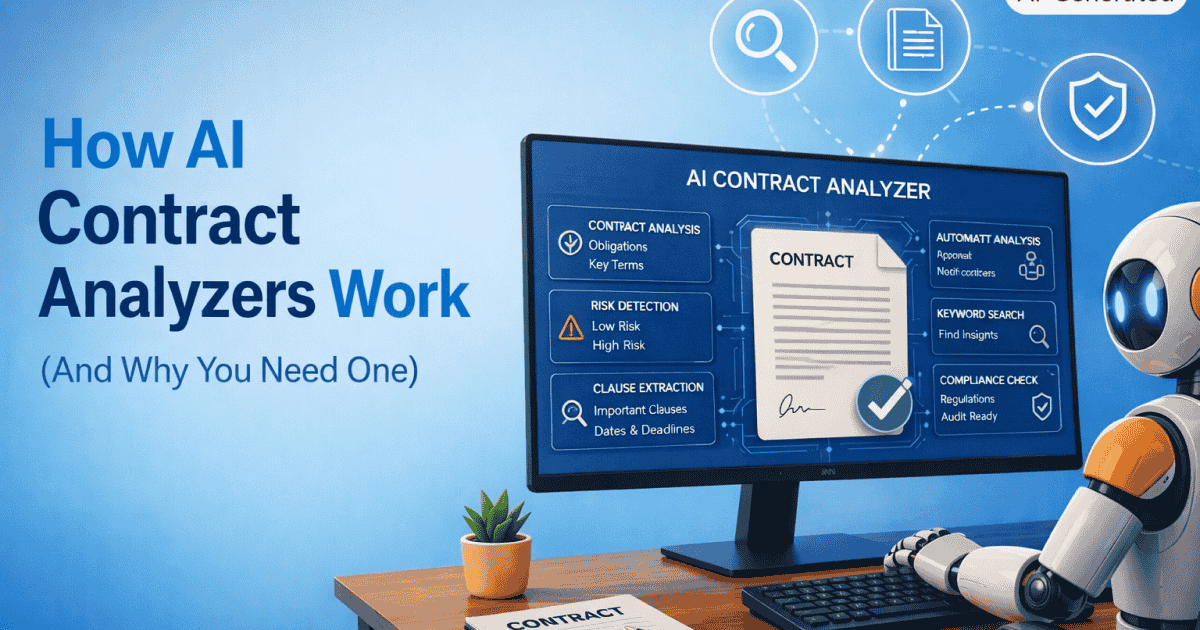
An AI contract analyzer is software that reads legal documents and extracts meaningful information from them — automatically. It doesn't just keyword-search for "termination" or "payment." It understands context, identifies clause types, compares language against common standards, and flags provisions that are unusual, missing, or potentially risky.
The best tools go further than flagging. They explain what a clause means in plain language, summarize the document's key terms, and highlight what's absent that probably should be there. Think of it less like a spell-checker and more like having a paralegal read the contract before you do.
It's worth being clear about what AI analysis is and isn't: it's an excellent first filter, not a substitute for legal counsel on high-stakes matters. The value is speed, consistency, and catching things you'd otherwise miss.
How AI Reviews Contracts: A Step-by-Step Breakdown
The process sounds complex, but from the user's side it's surprisingly simple. Here's what's actually happening when you upload a document to contract analysis software.
Step 1: Document Ingestion and Parsing
The first thing the AI does is convert your document into something it can work with. Whether you upload a PDF, Word file, or paste text directly, the system extracts the raw text while preserving the document's structure — which sections are headings, which are clauses, where paragraphs begin and end.
This sounds basic, but it matters. A poorly parsed document means the AI loses context — it can't tell where one clause ends and another begins. Good contract analysis software handles formatting quirks, scanned PDFs (via OCR), and inconsistent document structures without losing the thread.
Step 2: Clause Detection and Classification
Once the text is clean, the AI breaks the contract into its component parts. Contracts follow recognizable patterns — there's almost always a payment terms section, a termination clause, an indemnification provision, confidentiality language, and so on. The AI has been trained on thousands of contracts and knows what these sections look like even when they're written differently across documents.
This classification step is what makes AI contract analyzers so fast. Instead of reading linearly from top to bottom, the system jumps straight to the clauses that matter most for whatever you're reviewing — and can surface the right ones for your specific document type, whether that's an NDA, a SaaS agreement, an employment contract, or a lease.
Step 3: Risk Scoring and Flagging
Here's where the real value shows up. Once the AI has identified and classified the clauses, it evaluates them for risk. This means comparing the language against a baseline of what's "standard" for that type of clause in that type of agreement.
A liability cap that limits your damages to one month's fees might be typical in a software subscription agreement. In a construction contract involving significant physical risk, the same cap could be dangerously inadequate. The AI understands the difference because it's been trained on domain-specific contract data, not just generic legal language.
Flags typically fall into categories: missing clauses that should be present, unusual or one-sided language favoring the other party, vague terms that could lead to disputes, and provisions that conflict with each other or with applicable law.
Step 4: Plain-Language Explanation
Legal language is deliberately precise — which also makes it notoriously hard to read. A good AI contract analyzer doesn't just flag "this clause is unusual." It explains what the clause means, why it might be a problem, and what a more balanced version might look like.
This plain-language translation is arguably the most useful output for non-lawyers. If you're a freelancer reviewing a client contract, a founder signing a vendor agreement, or a small business owner finalizing a lease, you don't need to know the legal theory — you need to understand what you're agreeing to. AI makes that possible without a law degree.
Step 5: Summary and Action Points
Finally, the AI compiles everything into a usable summary: key parties, important dates, payment obligations, termination rights, and the flagged issues with suggested next steps. Instead of a 40-page document, you get a one-page digest of what actually matters.
This is what makes contract analysis software a genuine workflow tool, not just a novelty. You can review the summary, address the flagged points, and make informed decisions — without spending three hours on a document that may not even need major changes.
What Contract Analysis Software Actually Catches
The range of issues a well-built AI contract analyzer can surface is broader than most people expect. Here are the categories that come up most often.
Automatic Renewal Clauses
These are buried in service agreements more often than they should be. A contract auto-renews for another 12 months unless you cancel within a specific 30-day window. Miss the window, and you're locked in. AI catches these consistently because the language pattern is recognizable — even when it's tucked into a "Subscription Term" section on page 18.
One-Sided Indemnification
Indemnification clauses determine who covers legal costs if something goes wrong. A mutual indemnification is standard — both parties protect each other. A one-sided clause might require you to indemnify the other party for nearly anything, including their own negligence. That's a significant exposure that's easy to miss in a dense paragraph.
Unlimited Liability Provisions
Most contracts cap the damages one party can seek from the other. When that cap is missing or set too high, you're exposed in ways that can far exceed the value of the contract itself. Contract analysis software flags unlimited liability provisions and compares the cap (if one exists) to what's typical for the agreement type.
Vague Deliverable Definitions
In service agreements and project contracts, vaguely defined deliverables are a recipe for disputes. "Reasonable efforts," "timely delivery," and "satisfactory work" mean different things to different people. AI identifies these terms and flags them as ambiguous — because the vaguer the language, the harder it is to enforce or defend.
Intellectual Property Ownership
Who owns what you create? In freelance and employment agreements especially, IP clauses can be surprisingly sweeping. Some contracts assign all work product — including ideas developed on your own time — to the hiring company. AI surfaces IP clauses that go beyond what's typical so you can negotiate before signing.
Missing Clauses
This is what separates a good AI contract analyzer from a basic keyword tool: identifying what's not there. A contract missing a dispute resolution clause, a governing law provision, or a confidentiality agreement isn't necessarily void — but it creates gaps that become problems later. AI knows what should be in a given type of contract and tells you when it's absent.
Who Actually Needs Contract Analysis Software?
The short answer: anyone who signs contracts regularly but doesn't have a legal team reviewing them. That includes a lot of people.
Freelancers and independent contractors sign client agreements constantly — SOWs, NDAs, project contracts — often under time pressure. AI review takes 60 seconds and can catch a problematic IP clause before it becomes a dispute.
Small business owners deal with vendor contracts, lease agreements, and supplier terms that aren't always negotiated. Knowing what's in the contract — and what's unusual — lets you push back before signing.
Startup founders often sign term sheets, SAFE agreements, licensing deals, and partnership contracts early on, when legal mistakes are hardest to undo. A first-pass AI review catches the obvious issues so legal counsel can focus on what actually needs their attention.
HR and operations teams review employment agreements, contractor terms, and service provider contracts at volume. AI analysis helps maintain consistency and flags anything that deviates from your standard templates.
What AI Contract Analysis Can't Do (Yet)
Being honest about limitations matters. An AI contract analyzer is not the same as legal advice, and it shouldn't be treated as such.
AI can't tell you whether a clause violates a specific local law unless it's been trained on that jurisdiction's legal framework. It can't apply strategic judgment about whether to accept a risk based on your specific business relationship. And it can't negotiate for you.
What it can do is make sure you walk into a negotiation — or a signing — with your eyes open. The goal isn't to replace legal counsel for complex matters. It's to make sure the things that should be obvious are actually obvious, and that you're not signing something problematic because you were reading too fast.
For high-stakes contracts — equity agreements, significant commercial leases, M&A documents — use AI as a first pass and then involve a lawyer. For everyday business agreements, AI review often gets you 80–90% of the way there on its own.
How to Use an AI Contract Analyzer in Practice
Indigo E-sign AI Document Analyzer are built specifically for this workflow. You upload your contract, and the analyzer identifies the document type, extracts key clauses, explains the language in plain terms, and surfaces what needs attention — all without requiring legal training to interpret the results.
The practical workflow looks like this:
Upload your document — PDF or Word. The analyzer parses the structure and identifies clause types within seconds.
Review the flagged sections. Each flag includes an explanation of what the clause says, why it's worth attention, and how it compares to standard language for that contract type.
Use the summary to prepare your questions. If you're negotiating, the flags give you a starting point for what to push back on. If you're just reviewing for your own records, the summary tells you what you've actually agreed to.
And if you need to create the contract yourself rather than just analyze one you've received, that's a different but related problem — one that Indigo e-Sign also handles through its AI legal document generation tools.
Bottom Line
Contracts protect you — but only if you understand what's in them. Most people don't, not because they aren't smart, but because legal language is deliberately dense and signing deadlines don't leave time for careful review.
An AI contract analyzer changes that equation. It reads the document faster than you can, flags what matters, and explains it in language that doesn't require a law degree to follow. For freelancers, business owners, and anyone who signs agreements regularly, it's one of the most practical tools available.
Indigo e-Sign AI Document Analyzer is worth trying. It takes less time than reading the contract yourself — and catches things you'd almost certainly miss.
Disclaimer: This article is for informational purposes only and does not constitute legal advice. Always consult a qualified attorney for matters specific to your situation.
Frequently Asked Questions
Q1. What is an AI contract analyzer?
An AI contract analyzer is software that reads legal documents automatically, identifies and classifies clauses, flags risky or unusual language, and summarizes key terms in plain language. It acts as a first-pass review tool, helping you understand what you're signing without needing to parse dense legal text yourself.
Q2. How does AI review contracts differently from a lawyer?
AI reviews contracts for speed and consistency — it processes documents in seconds, identifies clause types, compares language to standard patterns, and surfaces red flags. A lawyer applies judgment, strategy, and jurisdiction-specific knowledge that AI currently can't replicate. For everyday contracts, AI provides strong value; for high-stakes agreements, use both.
Q3. What kinds of contracts can AI analyze?
Most AI contract analyzers handle common business agreements: NDAs, service contracts, freelance agreements, employment contracts, vendor terms, SaaS subscriptions, and commercial leases. More sophisticated tools also handle M&A documents, licensing agreements, and partnership contracts, though complex or jurisdiction-specific documents may still benefit from legal review.
Q4. Is AI contract analysis legally reliable?
AI contract analysis is a useful first-pass tool, not a legal opinion. It can accurately identify clause types, surface unusual language, and explain terms — but it can't apply jurisdiction-specific law, strategic judgment, or account for the full context of your business relationship. Treat it as an informed starting point, not a final answer.
Q5. How long does AI contract analysis take?
Typically seconds to under a minute for most standard-length contracts. A 20-page NDA or service agreement is processed and summarized almost instantly. Longer, more complex documents (50+ pages) may take slightly longer, but the time saved versus manual review is substantial regardless of document length.