What Is Contract Intelligence? The Complete Guide for Modern Businesses
What Is Contract Intelligence? The Complete Guide for Modern Businesses
In today's fast-paced digital economy, Contract Intelligence has emerged as an indispensable technology for organizations striving to maintain operational agility, ensure strict compliance, and accelerate revenue cycles. Historically, managing corporate agreements meant dealing with physical filing cabinets, fragmented shared drives, and static PDF documents buried in email threads. Highly skilled legal, procurement, and operations teams have spent countless hours manually reading dense legalese to track renewal dates, indemnity clauses, or renegotiation terms. As enterprises manage thousands—or even tens of thousands—of active agreements across multiple jurisdictions, manual oversight is no longer just slow; it introduces immense financial and legal risk.
Contract intelligence revolutionizes this paradigm by transforming static legal documents into dynamic, searchable, and structured data assets. By combining advanced Artificial Intelligence (AI) with semantic analysis, modern businesses can extract actionable insights from their contracts in seconds rather than weeks.
This comprehensive guide breaks down what this technology is, how it works under the hood, how it differs from traditional contract management software, the core benefits it delivers across departments, and how your business can successfully implement it.
1. What Is Contract Intelligence?
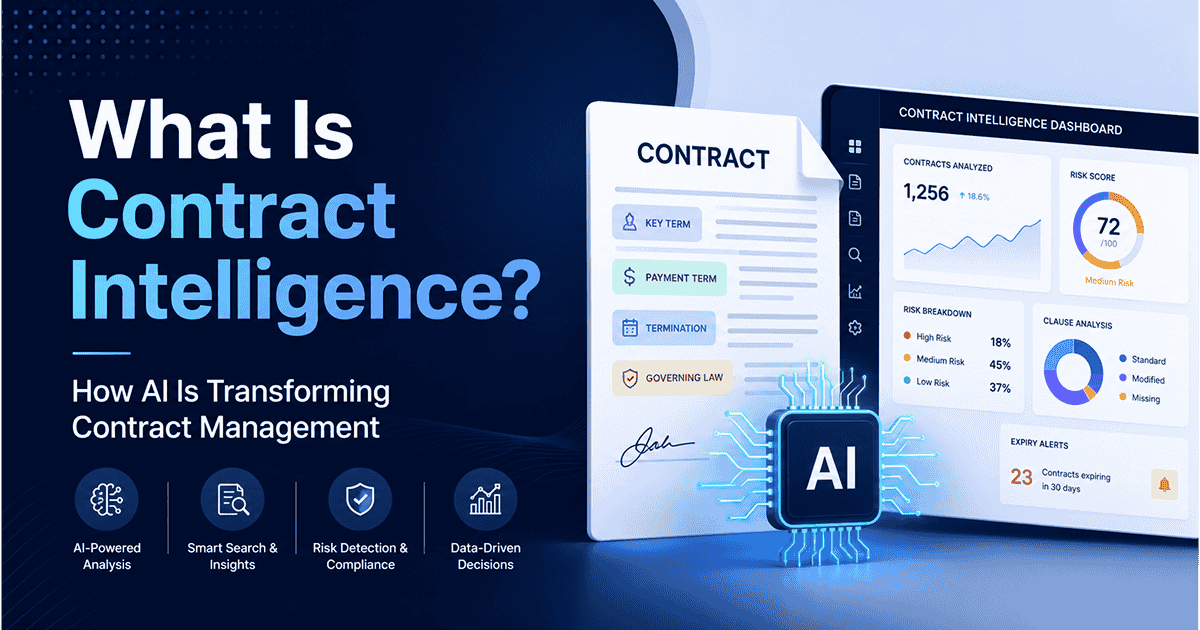
At its foundation, Contract Intelligence is the application of Artificial Intelligence (AI), Machine Learning (ML), and Natural Language Processing (NLP) to read, extract, analyze, and understand the contents of contractual documents across their entire lifecycle.
Instead of treating a contract as an immutable image file or static PDF, contract intelligence systems convert the text into structured metadata. The system reads individual clauses, identifies legal entities, understands the relationship between parent agreements and amendments, and extracts critical business terms such as:
- Key Milestone Dates: Renewal, expiration, and required notice windows.
- Financial Terms: Payment schedules, tiered pricing structures, and penalty clauses.
- Jurisdictional Data: Governing law, venue jurisdiction, and dispute resolution mechanisms.
- Liability & Risk Allocations: Indemnity limits, warranty obligations, and liability caps.
- Regulatory Commitments: Compliance mandates including GDPR, HIPAA, and CCPA standards.
Moving Beyond Simple Keyword Search (Ctrl+F)
It is crucial to differentiate true contract intelligence from simple digital text search. A basic keyword search only locates exact string matches. If you search for "Force Majeure," a standard search tool will skip any clause labeled "Unforeseen Events" or "Acts of God."
In contrast, contract intelligence leverages semantic understanding. It interprets the meaning and intent of legal language regardless of the specific terminology used by opposing counsel. It recognizes that a clause stating "neither party shall be liable for delays caused by strikes, floods, or civil unrest" constitutes an excusable delay provision, categorizing and scoring it accordingly.
2. Contract Intelligence vs. Traditional Contract Lifecycle Management (CLM)
Many organizations already utilize basic Contract Lifecycle Management (CLM) software or cloud storage repositories. While CLM systems serve an important administrative purpose, they lack the analytical depth of an intelligent contract platform.
The fundamental difference lies in workflow management versus deep data analysis. Traditional CLM manages the administrative path of a contract—routing it from drafting to approval, digital signature, and static archive. It tells you where a contract is in the pipeline. Contract Intelligence focuses on the content and risk profile within the contract. It interprets the rights, obligations, financial exposure, and commercial opportunities contained across your entire contract repository.
Detailed Comparison: Traditional CLM vs. AI Intelligence
Data Ingestion
- Traditional CLM: Manual data entry; staff must read and type key terms into forms.
- AI Intelligence: Automated ingestion and OCR extraction in seconds.
Search Mechanism
- Traditional CLM: Exact-match keyword query (fails on synonyms or rephrasing).
- AI Intelligence: Semantic and contextual search across unstructured legal text.
Risk Detection
- Traditional CLM: Relies entirely on human memory, checklists, and manual spot-checks.
- AI Intelligence: Proactive risk scoring; flags non-standard clauses instantly.
Legacy Contract Ingestion
- Traditional CLM: Extremely expensive and slow; requires third-party manual audits.
- AI Intelligence: Ingests thousands of legacy PDFs and scans within hours.
Reporting & Analytics
- Traditional CLM: Static spreadsheets based on outdated manual inputs.
- AI Intelligence: Real-time dashboards showing renewal pipelines and exposure.
Scalability
- Traditional CLM: Linear cost: more contracts require hiring more reviewers.
- AI Intelligence: Exponential scale: processes 10,000 contracts as fast as 10.
3. The Core Technologies Behind Contract Intelligence
Contract intelligence is made possible by the convergence of several sophisticated computer science disciplines working together in a seamless pipeline:
- Optical Character Recognition (OCR) & Document Layout Analysis
Before an AI model can parse legal language, it must read the document. Advanced OCR goes beyond basic character recognition by analyzing the spatial layout of documents—including multi-column layouts, tables, schedules, exhibits, and handwritten signatures—converting low-resolution scans and flattened PDFs into structured text.
- Natural Language Processing (NLP) & Legal Language Models (LLMs)
Legal drafting uses specialized vocabulary, complex conditional phrasing, and long nested sentences. NLP algorithms trained specifically on legal corpora parse these sentence structures to identify obligations ("shall"), permissions ("may"), and prohibitions ("shall not"), linking related terms across different sections of an agreement.
- Machine Learning & Semantic Pattern Matching
Machine learning models categorize clauses based on organizational historical data and established legal playbooks. When an incoming vendor agreement modifies your standard indemnification cap, the ML model identifies the deviation, calculates the delta, and alerts the legal team to the change.
4. Key Capabilities of Modern Contract Intelligence Platforms
A modern contract intelligence solution provides comprehensive capabilities that span both the pre-signature negotiation stage and post-signature lifecycle management.
Pre-Signature Phase Capabilities
- Automated Playbook Redlining: Scans third-party drafts against your corporate standard positions. It highlights missing mandatory terms, flags aggressive counterparty clauses, and suggests pre-approved alternative language.
- Deviation & Anomaly Detection
- Negotiation Guidance & AI Prompts
- Risk Assessment Scoring
Post-Signature Phase Capabilities
- Milestone and Obligation Tracking: Automatically maps out all date-driven obligations, including auto-renewal deadlines (preventing unintended vendor lock-in) and price adjustment windows.
- Regulatory Compliance Audits: Run portfolio-wide queries and identify every agreement requiring an amendment when new regulations take effect.
- Obligation & SLA Fulfillment Tracking
- Enterprise Spend & Revenue Analytics
5. Strategic Benefits Across Business Departments
While contract intelligence is often spearheaded by the General Counsel's office, its business impact extends across the entire enterprise:
Legal Teams
- 70% Faster Review: Automate routine document checks to drastically cut intake-to-signature turnaround times.
- Standardized Playbooks: Ensure all agreements automatically adhere to your approved corporate guidelines and risk thresholds.
- Strategic Focus: Free up highly skilled lawyers to focus on complex M&A, high-stakes negotiations, and proactive strategy instead of administrative triage.
Procurement & Supply Chain
- Eliminate Auto-Renewal Waste: Never miss a cancellation window for an unused or underperforming vendor subscription.
- Volume Rebate Discovery: Instantly identify overlapping contracts and unapplied bulk discounts across your global supply chain.
- Supply Continuity: Flag single-source dependencies, weak force majeure protections, or unfavorable termination clauses across vendor networks.
Sales & Revenue Operations
- Shorter Sales Cycles: Accelerate deal execution by removing redline bottlenecks on incoming revenue contracts.
- Frictionless Customer Deals: Provide a smoother, faster contracting experience for new clients, preventing deals from stalling in the final stages.
- Revenue Leakage Prevention: Ensure negotiated discounts, milestone billing triggers, and index-linked price increases are captured and billed on time.
6. How to Implement Contract Intelligence: A Step-by-Step Roadmap
Successfully rolling out contract intelligence requires a structured, phased approach. Trying to automate every workflow simultaneously can create internal friction. Follow this proven roadmap:
- Step 1: Centralize Your Repository
- The Goal: Consolidate legacy files into a single, secure digital store.
- The Process: Aggregate agreements from local drives, cloud storage folders, email inboxes, and physical archives into a unified, encrypted repository.
- Step 2: Define Rules & Playbooks
- The Goal: Document fallback clauses, risk caps, and legal priorities.
- The Process: Standardize your company's acceptable terms and non-negotiable legal thresholds. This critical step calibrates the AI models to your exact risk profile.
- Step 3: Launch a High-Volume Pilot
- The Goal: Target standard agreements first (NDAs, MSAs, SOWs).
- The Process: Begin implementation with standardized, high-frequency documents to establish baseline ROI metrics and refine internal processes.
- Step 4: Enterprise Integration
- The Goal: Connect the intelligence engine to your CRM, ERP, and internal workflows.
- The Process: Connect your platform directly to enterprise tools (such as Salesforce, HubSpot, or ERP systems) to maintain an automated flow of data from sales pitch to invoice.
For modern digital brands and enterprise platforms, pairing intelligent backend operations with clear, user-centric visual interfaces is essential. As demonstrated across forward-thinking digital platforms like Indigoesign, combining robust data architecture with intuitive design drives faster team adoption and long-term operational efficiency.
7. Future Trends in Contract Intelligence
As AI technology continues to advance, the contract management landscape is shifting from reactive analysis to predictive execution:
- Autonomous Drafting and Redlining: Generative AI engines will increasingly generate comprehensive, contextual redlines aligned directly with business objectives and counterparty negotiation histories.
- Predictive Dispute Analytics: Machine learning models will cross-reference draft contract terms with public litigation databases to calculate the statistical likelihood of future disputes based on clause structure.
- Smart Contract Integration: High-volume operational contracts will increasingly integrate with programmatic ledgers, triggering automatic invoice validation and milestone-based payments without manual intervention.
Frequently Asked Questions
Contract Intelligence is the use of artificial intelligence and machine learning to automatically read, analyze, and extract critical business terms from legal agreements, turning static documents into actionable data.
Standard CLM software manages the workflow, approval routing, and digital signature of documents. Contract intelligence analyzes the underlying text and legal meaning within those documents, highlighting risks, tracking deadlines, and comparing terms against internal standards.
No. Contract intelligence is designed to assist, not replace, legal professionals. It handles repetitive data extraction and initial reviews, allowing attorneys to make faster, more informed decisions on complex legal and strategic matters.
Is contract data kept confidential and secure when processed by AI?
Enterprise-grade contract intelligence platforms use dedicated, single-tenant or securely partitioned multi-tenant environments with end-to-end encryption (AES-256 at rest and TLS 1.3 in transit) and strictly avoid using customer data to train public foundation models.
Most enterprises achieve measurable ROI within 3 to 6 months through faster contract turnaround times, the elimination of missed auto-renewals, and reduced outside counsel expenditures on routine document reviews.