Vendor Agreement Review: Key Clauses Before You Sign
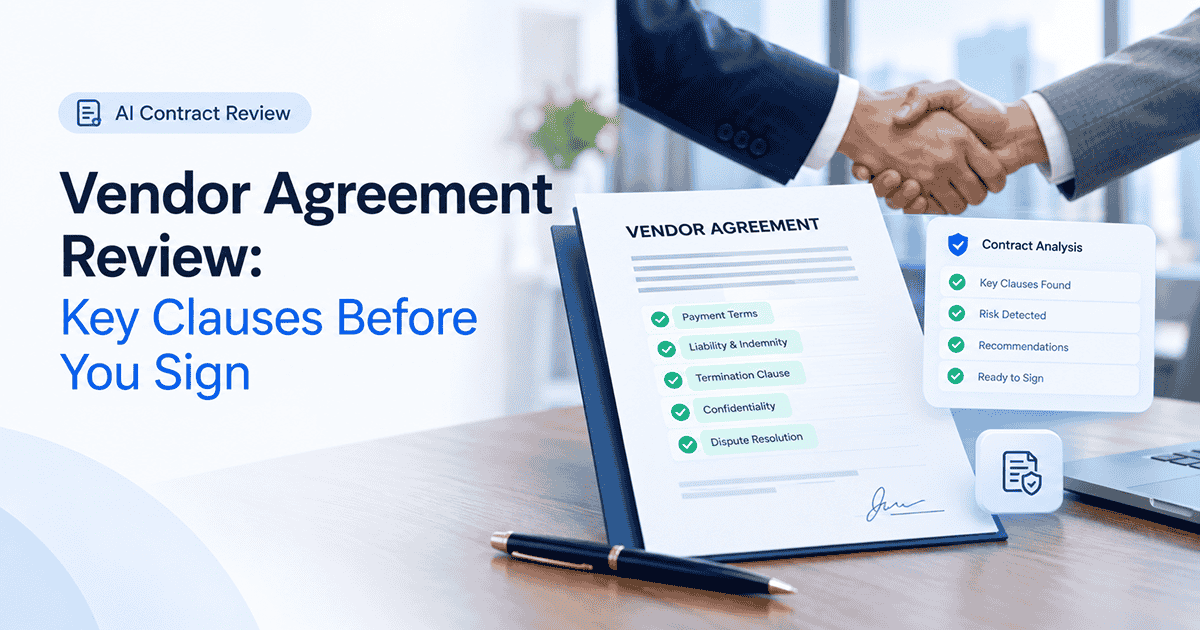
Vendor Agreement Review: Key Clauses Before You Sign
Every vendor relationship starts with a contract, and most businesses sign that contract faster than they should. A thorough vendor agreement review is the difference between catching a costly liability gap on page 12 and discovering it six months later when the vendor's service fails and you're left holding the bag. Whether you're bringing on a software provider, a logistics partner, or a marketing agency, the clauses buried in that agreement determine how much risk you're actually taking on — and most of them are easy to miss without a structured review process.
What Is a Vendor Agreement Review?
A vendor agreement review is the process of examining a contract with a supplier or service provider to identify obligations, risks, and terms that could affect your business before you sign. It's not just about reading the document — it's about knowing which clauses matter most, what “standard” language actually means in practice, and where vendors typically try to shift risk onto the customer.
Unlike a quick skim, a real review checks each clause against your company's risk tolerance, compares terms to industry norms, and flags anything that deviates from what's fair or expected. For procurement teams handling dozens of vendor contracts a year, this process either happens systematically — or it happens reactively, after something has already gone wrong and the damage is already done.
Why Vendor Agreement Review Matters
Vendor contracts aren't neutral documents. They're usually drafted by the vendor's legal team, which means the default language tends to favor the vendor — not you. A few examples of what's commonly at stake when a review gets skipped:
- Uncapped liability exposure if the vendor's product or service causes damage to your business
- Auto-renewal clauses that lock you into another year before you've even evaluated performance
- Vague SLA language that gives the vendor room to underperform without consequence
- Data ownership ambiguity, especially when the vendor processes or stores your customer data
- One-sided termination rights that make it hard for you to exit a bad relationship
None of these show up as red flags on a quick read. They show up in the fine print, often in clauses that sound routine until you compare them to what a fair agreement should actually say.
6 Key Clauses to Check During Vendor Agreement Review
1. Liability & Indemnification
This is usually the highest-stakes clause in the entire agreement. Check whether liability is capped, and if so, at what amount — some vendors cap liability at the value of fees paid, which can be far less than the damage a failure could actually cause. Also check who indemnifies whom: if the vendor's product infringes on someone else's IP or causes a data breach, does the vendor cover your legal costs, or are you exposed on your own?
2. Service Level Agreements (SLAs)
Vague SLA language is one of the most common ways vendors quietly avoid accountability. Look for specific, measurable commitments — uptime percentages, response times, resolution windows — and check what happens when those commitments aren't met. If there's no penalty or service credit tied to an SLA breach, the SLA is effectively unenforceable, no matter how good it sounds on paper.
3. Payment Terms & Penalties
Beyond the headline price, review payment schedules, late payment penalties, price escalation clauses, and any conditions that trigger additional fees. Some vendor agreements include automatic price increases tied to renewal periods that are easy to miss on a first read, only surfacing when the invoice arrives higher than expected.
4. Termination & Renewal Rights
Check both sides of this clause. Can you terminate for convenience, or only for cause? What's the required notice period? Does the contract auto-renew, and if so, how far in advance do you need to cancel to avoid being locked in for another term? Termination clauses that are hard to trigger are one of the biggest sources of vendor lock-in, and they're often the clause businesses regret not reading closely.
5. IP & Data Ownership
If the vendor will touch your data, code, or creative assets, this clause defines what happens to that material afterward. Confirm that your data remains your property, that the vendor's rights to use it are limited strictly to delivering the service, and that there's a clear data deletion or return process once the contract ends.
6. Confidentiality & Subcontracting
Check whether the vendor is allowed to subcontract any part of the work to a third party, and if so, whether that third party is bound by the same confidentiality and data protection terms you agreed to. A weak subcontracting clause can quietly expose your sensitive information to a company you never actually vetted or approved.
Common Mistakes Businesses Make When Reviewing Vendor Agreements
Even experienced procurement teams fall into a few predictable traps:
- Treating the review as a formality rather than a negotiation opportunity — most vendor terms are more flexible than they appear
- Focusing only on price and skimming the legal clauses that carry the real long-term risk
- Reusing an old review checklist that doesn't account for a new vendor's specific risk profile, like data handling or subcontracting
- Missing renewal deadlines because auto-renewal terms weren't flagged during the original review
- Reviewing in isolation, without comparing terms across multiple vendor contracts to spot which one is genuinely worse for the business
How AI Speeds Up Vendor Agreement Review
Manually reviewing every vendor contract clause-by-clause doesn't scale once you're managing more than a handful of vendor relationships. AI-powered contract review tools, like Indigo e-Sign's AI Contract Review, can scan a vendor agreement in seconds, flag high-risk clauses like uncapped liability or auto-renewal terms, and summarize obligations so your team knows exactly what to negotiate before signing — without waiting on outside counsel for every routine vendor contract. This doesn't replace legal review for high-stakes agreements, but it catches the common risk patterns instantly and speeds up the contracts that don't need a full legal cycle.
Frequently Asked Questions
A: The main purpose is to identify risks, obligations, and unfavorable terms in a vendor contract before signing — so your business isn't caught off guard by liability gaps, weak SLAs, or restrictive termination terms later.
A: Ideally, procurement, legal, and the business owner of the vendor relationship should all weigh in. Procurement handles commercial terms, legal reviews liability and compliance language, and the business owner confirms the SLA actually matches operational needs.
A: For standard, low-risk vendor contracts, a review can take under an hour with the right checklist or an AI-assisted tool. High-value or high-risk agreements — especially those involving sensitive data or long-term commitments — typically need more thorough legal review.
A: Uncapped liability combined with a weak termination clause is one of the most dangerous combinations — it means you're exposed to significant risk with limited ability to exit the relationship if things go wrong.
A: No. AI tools are effective at flagging common risk patterns and speeding up routine reviews, but high-stakes or unusually structured agreements still benefit from a lawyer's judgment, especially around liability caps and jurisdiction-specific compliance.