AI vs Manual Contract Review
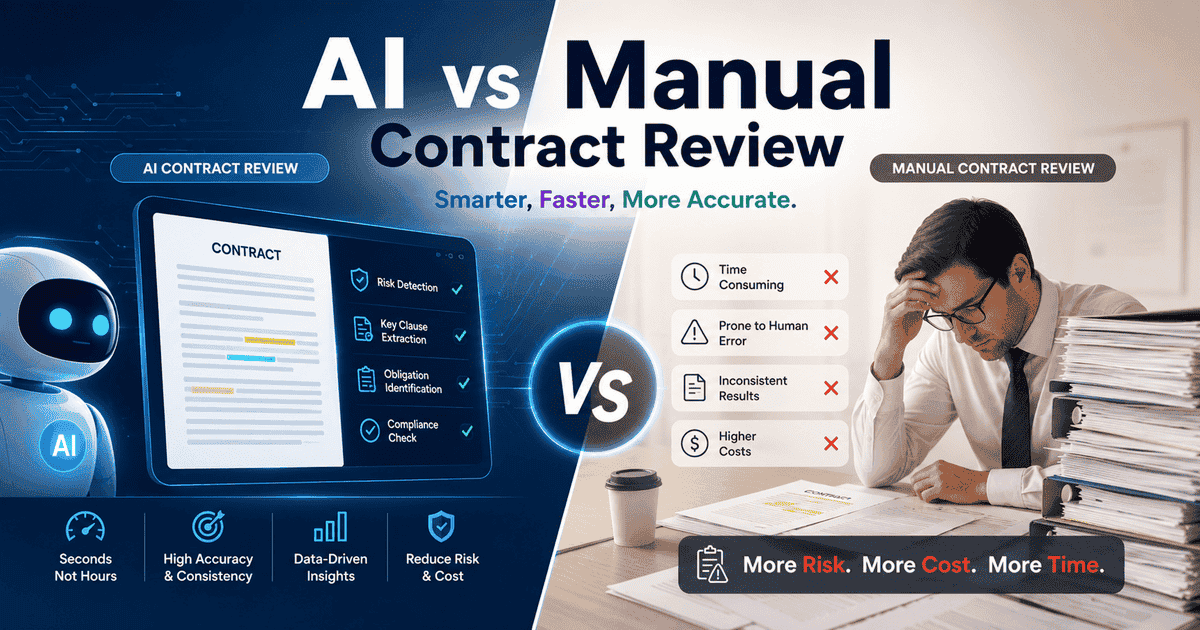
AI vs Manual Contract Review: The Ultimate 2026 Guide to Legal Efficiency
In the modern corporate landscape, the legal and procurement departments are under immense pressure to process agreements faster without compromising on risk management. For decades, the standard approach relied entirely on human expertise—lawyers reading dense text line by line. However, the rise of legal artificial intelligence has sparked a massive shift in how organizations handle their document pipelines. When looking at AI vs manual contract review, the debate is no longer about whether technology can read a contract, but rather how rapidly businesses must adopt it to stay competitive.
Historically, manual review has been the gold standard. A trained attorney or paralegal uses their education, context, and intuition to spot missing clauses, assess liabilities, and redline unfavorable terms. But as deal volumes scale and global supply chains become more complex, this linear, human-dependent process creates massive bottlenecks. Today, purpose-built AI engines use Natural Language Processing (NLP) and machine learning to analyze these same documents in seconds.
In this comprehensive guide, we will break down the true differences between AI and manual review, examining the hard data on speed, accuracy, and cost-effectiveness. We will also explore when human judgment remains irreplaceable, and how modern organizations are blending the two approaches to build the ultimate legal workflow.
1. The Core Mechanics: How Each Method Works
Before diving into the data, it is crucial to understand fundamentally how these two approaches differ in their execution.
The Manual Review Process
Manual contract review relies entirely on human cognition. When a vendor agreement or Non-Disclosure Agreement (NDA) hits a lawyer's desk, they must read through the text—often ranging from 10 to 100 pages—searching for specific terms, obligations, and risks. They cross-reference the document's language against the company's internal "legal playbook" and external regulatory statutes.
The human brain is exceptional at understanding nuance, business context, and strategy. However, the manual process is highly susceptible to cognitive fatigue. A lawyer reviewing their tenth contract on a Friday afternoon simply does not have the same level of granular focus as they did on Monday morning.
The AI Contract Review Process
AI contract review platforms do not "read" the way humans do; they use pattern matching and semantic understanding to parse the document. The AI ingests the file (using Optical Character Recognition if it is a scanned PDF) and breaks down the unstructured legal text into structured data.
Instead of reading linearly from page one to page fifty, the AI instantly scans the entire document simultaneously. It compares every single clause against millions of data points, jurisdiction-specific laws, and the company's customized playbook. It then highlights anomalies, flags missing protections, and suggests pre-approved fallback language in mere moments.
2. Speed and Efficiency: The 26-Second Revolution
The most dramatic difference between AI and human reviewers is the sheer velocity of the work. Time kills deals, and contracts stuck in legal limbo directly delay enterprise revenue.
The Human Baseline
In a landmark study conducted in collaboration with leading legal academics (including experts from Duke University and the University of Southern California), 20 top US corporate lawyers were tasked with reviewing standard business NDAs. These were highly experienced attorneys from global law firms and major corporations like Goldman Sachs and Cisco. On average, it took these seasoned lawyers 92 minutes to review the contracts and spot the issues. The fastest human completed the task in 51 minutes, while the slowest took over two and a half hours (156 minutes).
The AI Advantage
In that exact same controlled study, the AI platform completed the identical task in just 26 seconds.
This represents an astonishing 215x speed advantage for standard clause identification. In practical business terms, an AI can process a backlog of 1,000 legacy contracts over a weekend—a task that would take a team of paralegals several months of full-time work. By automating the "document archaeology" phase, sales cycles are drastically shortened, and procurement teams can onboard vendors without weeks of friction.
Legal Chain
To see how this speed translates into actual business value, try adjusting the variables in this interactive widget to calculate the potential ROI of AI vs Manual review for your organization:
3. Accuracy and Risk Mitigation: Breaking the Myth
A common misconception is that while machines are faster, humans are naturally more accurate. The data proves otherwise, specifically when it comes to routine, high-volume document review.
The 94% Benchmark
In the MIT-backed study mentioned above, the AI engine did not just beat the lawyers in speed; it outperformed them in accuracy. The AI achieved an average accuracy rate of 94% in surfacing risks within the NDAs. The human lawyers, despite their decades of experience, achieved an average accuracy rate of 85%. The highest-performing individual human tied the AI at 94%, while the lowest-performing human scored just 67%.
Why AI Wins on Routine Accuracy
Why does AI excel here? The answer is consistency. AI does not suffer from fatigue, distraction, or boredom. When checking compliance against over a million federal and state laws, an AI applies the exact same rigorous standard to the first clause as it does to the thousandth.
Human manual review has an estimated average error rate of about 4% on routine checks, simply because the human eye easily glosses over boilerplate text. If a single word is changed in a standard indemnity clause, an AI flags the deviation instantly, whereas a human skimming the familiar paragraph might miss the subtle but legally binding alteration.
4. Cost-Effectiveness and Scalability
The financial implications of transitioning from purely manual reviews to an AI-assisted model are profound.
The Cost of Manual Review
Manual review scales linearly. If your company doubles its contract volume, you must double your legal headcount or double your outside counsel budget. With corporate attorneys billing anywhere from $300 to $1,000+ per hour, routine document review becomes an exorbitant operational expense.
The Economics of AI
AI scales exponentially. Processing 10,000 contracts takes virtually the same amount of time and marginal cost as processing 10. AI review platforms typically bring the cost of a routine document review down to a fraction of traditional legal fees. Furthermore, it stops "revenue leakage" by ensuring that favorable payment terms, volume discounts, and renewal deadlines are meticulously tracked and executed.
5. When Manual Review Still Wins (The Hybrid Approach)
Despite the overwhelming metrics favoring AI for speed and routine accuracy, AI is not replacing lawyers. It is a powerful co-worker, not an autonomous substitute.
Justee AI
Manual review remains absolutely essential for:
- Strategic Business Judgment: AI can tell you that a liability cap is non-standard, but a human lawyer must decide if taking on that extra risk is worth winning a massive enterprise client.
- Novel Legal Arguments: AI relies on historical data and existing statutes. For highly unique, never-before-seen deal structures or complex Mergers & Acquisitions, human legal ingenuity is required.
- Negotiation Strategy: AI can draft alternative clauses, but humans manage the interpersonal relationships, leverage, and emotional intelligence required to close a contentious negotiation.
The future of the legal industry is hybrid. Legal teams use AI to handle the "first pass"—automating the data extraction, routine compliance checks, and standard redlining. This frees the human professionals to focus purely on high-level strategy and complex judgment calls.
6. Detailed Comparison: AI vs. Manual Contract Review
To summarize the differences, here is a detailed breakdown of how both methods perform across key business metrics:
Speed and Processing Time
- Manual Review: Averages 1.5 to 2 hours for standard commercial agreements; highly vulnerable to backlogs and bottlenecks.
- AI Review: Processes standard documents in under 2 minutes (often seconds); instant, concurrent processing with zero queuing.
Accuracy and Consistency
- Manual Review: Averages 85% accuracy for routine issue-spotting; highly dependent on the individual reviewer's experience, focus level, and fatigue.
PR Newswire - AI Review: Averages 94%+ accuracy for routine issue-spotting; delivers 100% consistent results without cognitive fatigue.
Cost to Scale
- Manual Review: Linear scaling; requires expensive headcount growth or high outside counsel billable hours (300-1000+).
- AI Review: Exponential scaling; processes thousands of documents at a flat subscription rate or low per-document cost (1-2 for basic extraction).
Best Use Cases
- Manual Review: Strategic negotiations, novel legal structuring, emotional intelligence in deal-making, and high-risk judgment calls.
vallor.ai - AI Review: High-volume NDAs, compliance audits, legacy contract digitization, deadline tracking, and standard playbook redlining.
7. The Role of Design in AI Adoption
Implementing AI into a traditional legal department requires more than just powerful algorithms; it requires exceptional user experience (UX). If an AI tool is difficult to use or visually overwhelming, adoption rates will plummet, and teams will revert to their manual, spreadsheet-based habits.
For modern digital brands and enterprise platforms, pairing intelligent backend operations with clear, user-centric visual interfaces is essential. As demonstrated across forward-thinking digital platforms like Indigoesign, combining robust data architecture with intuitive design drives faster team adoption, reduces internal friction, and ensures long-term operational efficiency. The best AI tools present complex legal data in clean, actionable dashboards that anyone from sales to procurement can understand at a glance.
Frequently Asked Questions
Manual review requires a human to read every word of a contract to identify risks and obligations, which is slow and subject to fatigue. AI contract review uses Natural Language Processing to instantly scan, extract data, and compare clauses against legal databases in seconds.
For routine tasks like clause identification in standard contracts (like NDAs), yes. Studies show AI can achieve up to 94% accuracy compared to an average of 85% for experienced attorneys, largely because AI does not suffer from cognitive fatigue or distraction.
No. AI acts as a powerful co-worker that handles the repetitive "first pass" of a contract. Human lawyers are still strictly required for complex negotiations, novel legal structuring, and making strategic business judgment calls regarding risk.
In controlled studies, AI has analyzed standard commercial agreements in as little as 26 seconds, compared to an average of 92 minutes for a human reviewer. This represents a massive reduction in turnaround times, helping sales and procurement teams move faster.
Modern AI systems can review almost any standard business agreement, including NDAs, Master Services Agreements (MSAs), employment contracts, lease agreements, and vendor scopes of work. However, highly bespoke or unique joint-venture agreements still require heavy manual oversight.