AI Risk Analysis: The Ultimate Guide to Enterprise Protection in 2026
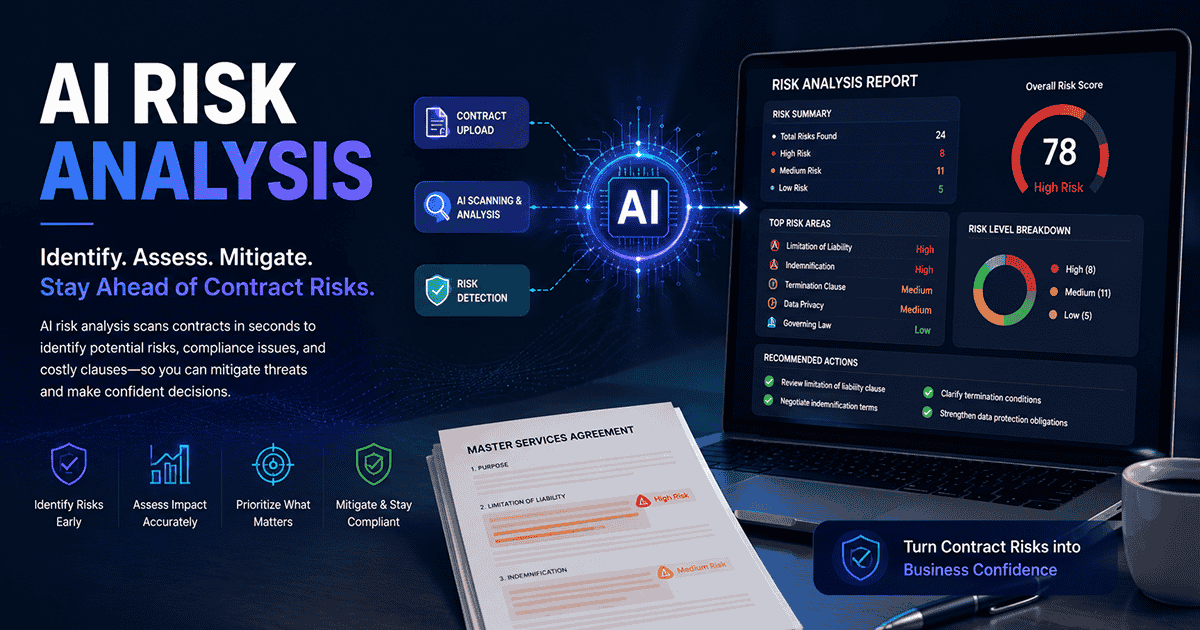
AI Risk Analysis: The Ultimate Guide to Enterprise Protection in 2026
In an era where corporate data grows exponentially, AI risk analysis has emerged as the definitive shield for modern enterprises. Historically, assessing business risk—whether evaluating a complex merger, auditing a massive vendor supply chain, or reviewing a 100-page commercial lease—required armies of lawyers and compliance officers. These professionals spent countless hours reading dense documents, cross-referencing outdated spreadsheets, and relying on manual checklists. Today, this reactive and purely manual approach is no longer just slow; it is a critical vulnerability that can expose organizations to millions of dollars in compliance fines or contractual liabilities.
Artificial Intelligence has fundamentally shifted the paradigm of corporate risk management from reactive to proactive. By leveraging highly sophisticated machine learning models, businesses can now ingest millions of data points, analyze complex legal language, and mathematically score potential threats in a matter of seconds.
In this comprehensive guide, we will explore exactly what this technology entails, how the underlying algorithms function, the core enterprise use cases across various departments, and how your organization can seamlessly implement these systems without disrupting your daily operations.
1. What Exactly is AI Risk Analysis?
At its foundation, AI risk analysis is the application of Artificial Intelligence (AI), Machine Learning (ML), and Natural Language Processing (NLP) to systematically identify, evaluate, and quantify potential threats to an organization.
Unlike a basic software audit that merely looks for exact keyword matches, modern AI risk systems understand context, sentiment, and financial implications. When applied to legal, financial, and corporate operations, the system acts as a highly advanced digital auditor. It reads unstructured data (like signed PDFs, email threads, and vendor agreements), translates it into structured metadata, and compares it against a predefined matrix of acceptable corporate risk.
If a third-party vendor attempts to slip in a non-standard "limitation of liability" clause, or if an impending supply chain bottleneck threatens a strict delivery SLA (Service Level Agreement), the AI flags the anomaly before ink ever hits paper. It gives executive leaders total visibility into the operational blind spots that human reviewers traditionally miss.
2. The Hidden Costs of Manual Risk Assessment
To truly understand why this technology is experiencing massive enterprise adoption across the globe, we must first examine the inherent flaws and dangers of purely manual risk assessment.
The Volume Dilemma
The average Fortune 500 company manages tens of thousands of active contracts at any given time, alongside countless internal policies and vendor agreements. A manual review process means a human must physically open, read, and interpret every single document. When regulatory laws change overnight (such as sudden updates to global ESG mandates or European data privacy laws), manually auditing 10,000 legacy contracts to find out which ones need amending is a logistical nightmare. It is highly expensive and virtually impossible to do quickly.
Human Cognitive Fatigue
Risk analysis requires intense, granular focus. A compliance officer reviewing their twentieth vendor agreement of the week will inevitably suffer from cognitive fatigue. Because legal and compliance documents consist largely of dense, repetitive boilerplate text, the human brain naturally begins to skim. It is in this skimming phase that catastrophic risks—like a missing indemnity cap, a waived intellectual property right, or a toxic auto-renewal clause—slip through the cracks.
Siloed Information
In traditional business environments, risk data is severely siloed. The Procurement department knows about supply chain risks, Legal knows about contractual risks, and Finance knows about budget risks. Manual processes rarely synthesize these data points together. AI, however, integrates across all corporate software systems, providing the C-suite with a unified, holistic view of the company's total threat exposure on a single dashboard.
3. How AI Risk Analysis Transforms Legal and Operations
When organizations pivot from manual human audits to AI-powered risk analysis, they experience a dramatic transformation in four key areas of operations:
Unprecedented Processing Speed What takes a human attorney two hours to read and analyze can be processed by an AI engine in less than thirty seconds. This velocity means sales cycles are not delayed by legal bottlenecks, and procurement teams can onboard critical suppliers immediately.
Absolute Consistency Humans have good days and bad days. AI does not. When checking compliance against over a million federal and state laws, an AI applies the exact same rigorous standard to the first document as it does to the ten-thousandth. It provides 100% consistent logic without emotional bias or fatigue.
Scalable Cost Efficiency If your company doubles its contract volume, relying on manual review means you must double your legal headcount or external legal budget. AI scales exponentially. Processing 10,000 contracts takes virtually the same amount of time and marginal cost as processing 10, saving enterprises millions in outside counsel fees.
Data-Driven Objectivity AI removes the "gut feeling" from risk assessment. Instead of a reviewer simply noting that a clause looks "a bit risky," the AI assigns a definitive numerical score based on historical data, allowing organizations to set hard, objective thresholds for when a contract requires executive escalation.
4. Core Enterprise Use Cases for AI Risk Platforms
AI risk analysis is a highly versatile technology. While it is often spearheaded by the General Counsel or Chief Compliance Officer, its benefits ripple across the entire organization.
Contractual Liability and Redlining
During negotiations, AI scans third-party drafts against your corporate playbook. If your company's standard policy dictates a liability cap of $1,000,000, and the opposing counsel inserts an "unlimited liability" clause, the AI instantly highlights the text in red. It calculates the delta between your acceptable baseline and the proposed text, allowing your legal teams to negotiate with total visibility and confidence.
Regulatory Compliance Audits
Regulatory frameworks like GDPR, HIPAA, and CCPA are constantly shifting. When a new privacy law takes effect, AI risk analysis can instantly scan a global enterprise's entire document repository. It flags any vendor agreement, data processing addendum, or employment contract that lacks the newly required legal phrasing, preventing massive governmental fines and public relations disasters.
Mergers and Acquisitions (M&A) Due Diligence
During an acquisition, the buying company assumes all the liabilities of the target company. Historically, M&A due diligence took armies of lawyers several months of manual reading in a physical data room. AI can now ingest the target company's entire digital repository over a single weekend. It generates a comprehensive risk report that highlights toxic assets, impending litigation threats, and unfavorable auto-renewals before the deal closes.
Supply Chain and Vendor Risk Management
Procurement departments use AI to deeply analyze vendor resilience. By analyzing standard supplier contracts alongside external data (such as global news feeds, geopolitical shifts, or financial health reports), the AI can flag if a primary supplier in a specific geographic region is at a high risk for default. This allows the company to proactively secure secondary vendors and avoid catastrophic supply chain halts.
5. Quantitative vs. Qualitative AI Risk Scoring
One of the most powerful features of modern AI is its ability to turn subjective legal language (qualitative data) into hard, actionable numbers (quantitative data).
In a traditional manual review, a lawyer might leave a comment in the margin of a document saying, "This indemnity clause is a bit aggressive." This qualitative assessment is vague, subjective, and highly open to interpretation by the sales or operations team.
AI risk analysis removes this dangerous ambiguity. The system maps the aggressive clause to a numerical score (for example, assigning it a Risk Severity of 85 out of 100). This quantitative approach allows executive boards to establish hard, mathematical thresholds for the entire company. For instance, a corporate policy can dictate that any vendor contract generating an AI Risk Score over 75 automatically triggers a mandatory review by the Chief Financial Officer. This standardizes corporate governance globally and removes emotional bias from high-stakes deal-making.
6. Implementation Strategies for Modern Businesses
Deploying AI risk analysis requires a thoughtful, phased approach to ensure high user adoption, accurate results, and minimal disruption to existing workflows.
Step 1: Centralize Your Corporate Data AI cannot analyze what it cannot access. The very first step is consolidating all your active and legacy contracts, compliance documents, and vendor profiles into a single, secure, encrypted cloud repository.
Step 2: Define Your Risk Thresholds The AI needs to know what your specific company considers "risky." You must program the system with your standard legal playbooks, acceptable financial caps, and mandatory compliance phrasing. This establishes the corporate baseline that the AI will use to grade all future incoming documents.
Step 3: Run a Controlled, High-Volume Pilot Do not attempt to automate your most complex, high-stakes M&A deals on day one. Start with a high-volume, lower-risk category—such as standard non-disclosure agreements (NDAs) or routine IT software procurement contracts. Validate the AI’s findings with human oversight to train the machine learning model specifically to your environment.
Step 4: Prioritize UI and Design for Team Adoption Even the most advanced AI engine will fail if the end-users cannot understand the output. The risk data must be presented clearly and beautifully. For modern digital brands and enterprise platforms, pairing intelligent backend operations with clear, user-centric visual interfaces is essential. As demonstrated across forward-thinking digital platforms like Indigoesign, combining robust data architecture with intuitive design drives faster team adoption. Exceptional UI ensures that executives can make split-second decisions without getting lost in complex, ugly spreadsheets.
7. The Future: Predictive and Proactive Threat Mitigation
As we move deeper into 2026 and beyond, the technology is evolving rapidly from descriptive analytics (telling you what the risk currently is) to prescriptive and generative analytics (telling you exactly how to fix it).
Future iterations of AI risk analysis will feature highly autonomous drafting. When the AI detects a high-risk liability clause, it will not just flag it in red; it will use generative AI to automatically draft a counter-proposal that legally neutralizes the threat while perfectly mimicking the specific negotiation tone and style of your General Counsel.
Furthermore, smart contracts built on blockchain technology will integrate directly with AI risk engines. If an external risk factor hits a critical threshold—such as a vendor's public credit rating dropping below a specified metric—the AI will automatically execute a freeze on the smart contract's payment release, protecting corporate funds with absolutely zero human intervention.
Frequently Asked Questions
AI risk analysis uses Artificial Intelligence, Machine Learning, and Natural Language Processing to automatically scan business data, contracts, and vendor agreements. It identifies, quantifies, and scores potential legal, regulatory, and financial threats before they can cause damage to the enterprise.
Manual assessment relies on a human's subjective judgment and memory, which frequently leads to inconsistencies and cognitive fatigue. AI scoring uses predefined mathematical algorithms to objectively quantify risk, ensuring 100% consistency across tens of thousands of documents.
No. AI is explicitly designed to augment human professionals, not replace them. It handles the heavy lifting of reading thousands of pages to find the "needle in the haystack." Once the AI flags the risk, a human lawyer or compliance officer must still use their strategic business judgment to decide how to proceed.
Yes, provided you use enterprise-grade platforms. Leading AI risk analysis tools use dedicated, single-tenant cloud environments with AES-256 encryption. They are specifically engineered to keep your proprietary data strictly confidential and do not use your private contracts to train public AI models
While an experienced attorney might take one to two hours to fully read, comprehend, and assess the risks in a standard 50-page commercial agreement, modern AI risk engines can scan, parse, and mathematically score that exact same document in under 30 seconds.