AI Contract Summarization: The Ultimate Guide to Faster Legal Reviews
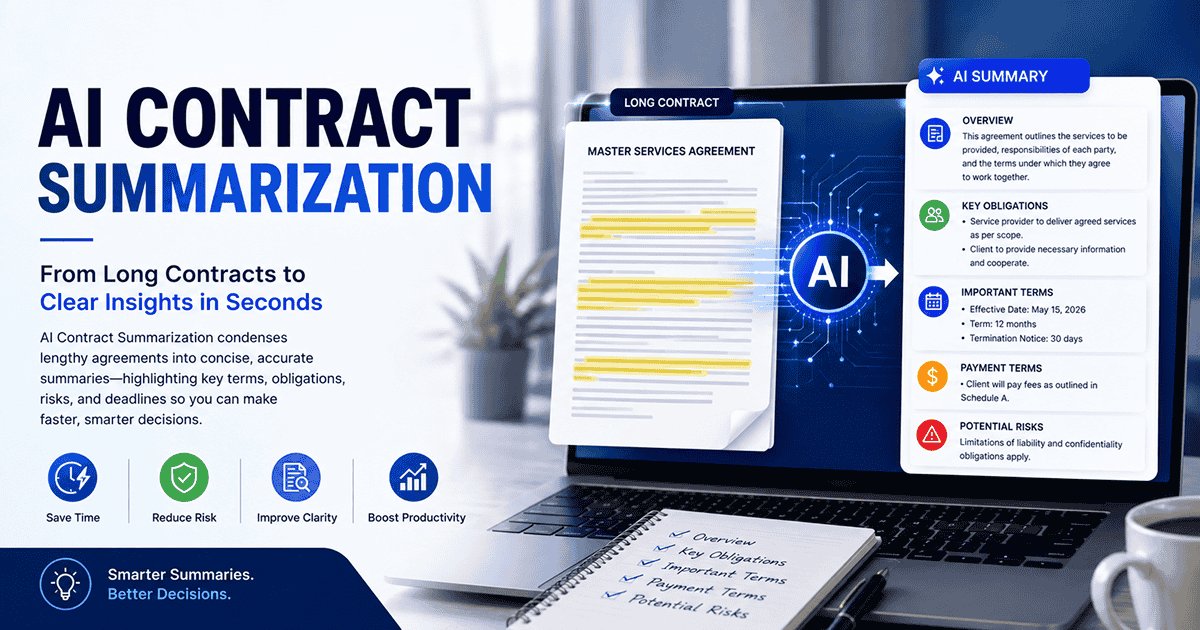
AI Contract Summarization: The Ultimate Guide to Faster Legal Reviews
In the fast-paced corporate world, reading a 100-page legal agreement just to grasp the core obligations is no longer a sustainable business practice. That is exactly why AI contract summarization has become one of the most transformative tools for modern legal and operations teams. Historically, creating an executive summary of a Master Services Agreement (MSA) or a complex vendor contract required a highly paid lawyer to spend hours reading, taking notes, and translating dense "legalese" into plain English for business leaders.
Today, artificial intelligence has completely flipped this paradigm. By leveraging advanced Large Language Models (LLMs) and Natural Language Processing (NLP), businesses can instantly generate highly accurate, easily digestible summaries of their most complex documents. This technology bridges the gap between the legal department and the rest of the business, ensuring that sales reps, procurement managers, and C-suite executives know exactly what they are agreeing to—without needing a law degree to understand it.
In this comprehensive guide, we will dive deep into what this technology is, how it utilizes generative AI to create human-readable summaries, the massive benefits it delivers across corporate departments, and how your organization can successfully implement it.
1. What is AI Contract Summarization?
At its most fundamental level, AI contract summarization is the use of artificial intelligence software to automatically condense a lengthy, complex legal document into a concise, easy-to-read overview. It highlights the most critical data points—such as effective dates, financial obligations, liability caps, and termination rights—and presents them in plain, understandable language.
To fully understand this technology, it is important to distinguish between the two primary ways AI handles summarization:
Extractive Summarization
Older, legacy AI systems used "extractive" summarization. This method acts like a digital highlighter. The AI scans the document, finds important sentences, and literally extracts them, pasting them into a new document. While this saves time, the final summary is still written in dense, complex legalese because it is just a copy-paste of the original text.
Abstractive (Generative) Summarization
Modern AI platforms utilize "abstractive" summarization powered by generative AI (like the technology behind ChatGPT). Instead of just copying sentences, the AI actually reads and comprehends the entire document. It then generates an entirely new, freshly written summary in plain English. For example, a convoluted three-page liability clause can be abstracted into a single bullet point that says: "The vendor's maximum liability is capped at $50,000, excluding cases of gross negligence."
This abstractive capability is what makes modern AI contract summarization so revolutionary for business workflows.
2. Why Manual Summarization is a Massive Bottleneck
For decades, creating contract summaries has been a manual, painstaking process. When a deal is ready to be signed, the executive leadership team usually requests a "brief sheet" or a summary of the key terms before they approve the final signature.
The manual approach to this creates several critical bottlenecks:
- Exorbitant Time Costs: An experienced attorney might take two to three hours to carefully read a 70-page commercial lease and draft a one-page summary. When multiplied across hundreds of contracts per month, this represents a massive drain on legal resources.
- Inconsistent Formatting: If you have five different lawyers summarizing contracts, you will get five completely different formats. One lawyer might focus heavily on data privacy, while another might focus on financial terms, making it impossible for executives to compare deals side-by-side.
- The Translation Gap: Lawyers naturally write like lawyers. When they manually summarize a contract, they often use legal terminology that confuses the sales or marketing executives who actually have to execute the project.
- Human Error: When reviewing a massive stack of documents, human reviewers suffer from cognitive fatigue. It is incredibly easy to accidentally leave out a crucial renewal date when manually typing up a summary late on a Friday afternoon.
3. How AI Contract Summarization Actually Works
The ability to turn 50 pages of dense legal text into a clear, one-page brief in 15 seconds seems like magic, but it is actually the result of a highly structured computational pipeline.
Step 1: Document Ingestion and OCR
First, the contract is uploaded into the AI platform. If the document is a scanned PDF or a flat image file, the system uses Optical Character Recognition (OCR) to read the pixels and convert them into machine-readable text. It also analyzes the document's layout to understand headers, tables, and signature blocks.
Step 2: Context Parsing and Clause Detection
Next, Natural Language Processing (NLP) algorithms break the document down into its component parts. The AI identifies the jurisdiction, the governing law, and the specific clauses (e.g., indemnification, force majeure, and confidentiality). It does not just look for keywords; it maps the semantic relationships between different paragraphs, understanding how an amendment on page 40 modifies a definition on page 2.
Step 3: LLM Generation and Formatting
Finally, a large language model (LLM) takes this mapped data and begins generating the summary. The system follows predefined prompts (e.g., "Summarize the financial obligations in bullet points using a maximum of 50 words"). The LLM outputs a clean, standardized, plain-English summary that can be instantly exported to a PDF, an email, or directly into a CRM dashboard.
4. The Top Benefits for Modern Enterprises
Implementing AI contract summarization creates a ripple effect of efficiency throughout an entire organization.
Drastic Time Savings for Legal Teams
The most immediate benefit is the time saved by the legal department. By automating the creation of executive summaries, in-house counsel can reclaim thousands of hours per year. Instead of acting as administrative summarizers, lawyers can practice at the top of their license—focusing on complex negotiations, M&A strategy, and proactive risk management.
Democratizing Legal Data
Contracts govern every aspect of a business, yet they are usually locked away in legal silos. AI summarization "democratizes" this data. It allows a sales manager to instantly understand the delivery obligations of a contract without having to ask the legal team for translation. It empowers project managers to know exactly when their project milestones are due based on the clear, plain-English summary.
Standardized Corporate Reporting
Because the AI follows strict programming parameters, every single summary it generates looks exactly the same. The financial terms are always in the first section, the liabilities are always in the second, and the dates are always bulleted at the bottom. This consistency allows executive boards to review dozens of contracts rapidly, knowing exactly where to look for the information they need.
5. Key Elements an AI Summary Should Include
When configuring an AI summarization tool, you must instruct the system on what data points are most important to your specific business. A highly effective, standardized AI contract summary should universally extract and highlight:
- Core Entities and Effective Dates: Who are the exact legal parties involved, when does the contract begin, and when does it naturally expire?
- Financial Terms and Schedules: What is the total contract value? What are the payment terms (e.g., net 30, net 60)? Are there any penalties for late delivery?
- Termination Rights: Can the contract be terminated for convenience, or only for a material breach? How many days of written notice are required?
- Liability and Indemnity Caps: What is the maximum financial exposure your company faces if something goes wrong?
- Unusual or High-Risk Provisions: Does the contract contain non-compete clauses, exclusivity agreements, or aggressive auto-renewal traps?
6. Real-World Use Cases by Department
AI contract summarization is not just a tool for lawyers. Its most profound impact is felt by the business units that rely on contract data to operate daily.
Sales and Revenue Operations
Sales teams are notoriously impatient with legal delays. When a massive enterprise deal is finally negotiated, the VP of Sales often needs a quick summary of the final terms to present to the CEO for final signature approval. AI summarization generates this brief instantly, preventing the deal from stalling at the finish line and ensuring the sales rep gets their commission faster.
Procurement and Supply Chain
Procurement teams manage thousands of vendor agreements. When a supply chain crisis occurs, they do not have time to read every contract to see who is responsible for shipping delays. By generating instant summaries of vendor SLAs (Service Level Agreements) and force majeure clauses, procurement teams can quickly assess their leverage and pivot to secondary suppliers if necessary.
Executive Leadership (M&A Due Diligence)
During a merger or acquisition (M&A), the purchasing company must review thousands of the target company's contracts (employment agreements, vendor contracts, and IP licenses) in a process called due diligence. Manually summarizing these takes armies of lawyers and costs millions of dollars. AI can summarize 10,000 legacy contracts over a single weekend, providing the executive team with a clear, aggregated risk report before they finalize the acquisition.
7. Best Practices for Implementation
To get the most out of your AI contract summarization platform, organizations must adopt a strategic approach to implementation.
- Clean Your Data First: AI requires clean, centralized data to function properly. Before rolling out a summarization tool, consolidate your contracts from scattered hard drives and email inboxes into a secure, centralized cloud repository.
- Customize Your Prompts (Playbooks): Do not rely solely on out-of-the-box settings. Customize the AI's prompts so the summaries match your corporate style. If your CEO prefers three bullet points instead of paragraphs, program the LLM to output bullet points.
- Maintain a Human-in-the-Loop (HITL): AI is incredibly accurate, but it is not infallible. For high-stakes, multi-million dollar agreements, always use a "Human-in-the-Loop" workflow. The AI generates the summary in 15 seconds, and a human lawyer spends 5 minutes reviewing it for strategic nuance before sending it to the board.
- Prioritize Design and User Experience (UX): The best AI in the world is useless if the interface is clunky and hard to read. Your AI summaries must be presented on clean, intuitive dashboards that integrate directly with the tools your team already uses (like Salesforce or Microsoft Teams). As demonstrated by forward-thinking digital platforms like Indigoesign, pairing robust backend data architecture with exceptional, user-centric visual design is the key to driving high user adoption and long-term operational efficiency.
The Future of AI in Legal Document Summaries
The landscape of legal tech is evolving at breakneck speed. Currently, AI contract summarization provides a static snapshot of a finalized agreement. In the near future, these summaries will become dynamic and interactive.
Imagine a dashboard where an executive can chat directly with the summary. They could type, "What happens to our pricing if inflation hits 5%?" and the AI will instantly reference the summarized data to provide a contextual answer. Furthermore, we will see deep integrations where AI summaries automatically trigger workflows—such as automatically sending an invoice from the accounting software on the exact date specified in the AI's financial summary.
Frequently Asked Questions
AI contract summarization is the use of artificial intelligence and Natural Language Processing (NLP) to automatically read lengthy legal documents and condense them into short, plain-English executive summaries, highlighting key terms, dates, and financial obligations.
Extractive summarization simply copies and pastes important sentences directly from the contract, maintaining the complex legal jargon. Abstractive summarization uses Generative AI to actually comprehend the text and rewrite the concepts into a brand new, easy-to-read summary in plain English.
No. An AI summary is an administrative tool used for quick reference and business intelligence. The original signed contract remains the sole legally binding document. Summaries are designed to help business leaders understand the deal, but they do not replace the actual contract in a court of law.
While legal teams save thousands of hours of manual labor, sales, procurement, and executive leadership teams benefit immensely. It democratizes legal data, allowing non-lawyers to instantly understand delivery dates, vendor SLAs, and compliance requirements without waiting for legal translation.
Yes, many modern enterprise AI platforms are equipped with multilingual Large Language Models (LLMs). They can ingest a contract written in Spanish or Mandarin, analyze the legal concepts, and instantly output a highly accurate executive summary in English.