AI Clause Detection: The Ultimate Guide to Automated Contract Review
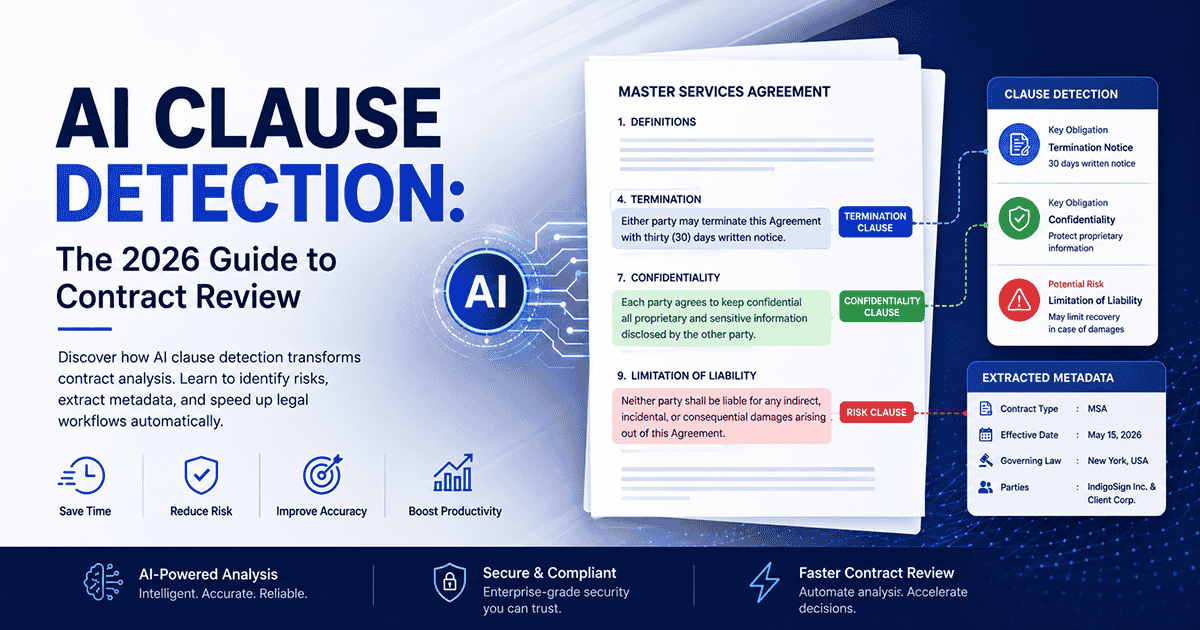
AI Clause Detection: The Ultimate Guide to Automated Contract Review
In the complex world of modern enterprise operations, the speed of business is often dictated by the speed of legal and procurement reviews. Historically, legal professionals have had to manually comb through hundreds of pages of dense text just to find a single liability limit or an obscure renewal date. Today, AI clause detection has completely revolutionized this process. By utilizing advanced artificial intelligence to instantly read, understand, and extract specific legal provisions from massive document repositories, businesses are drastically reducing their risk exposure while accelerating their deal cycles.
Whether you are managing a handful of high-stakes vendor agreements or tens of thousands of routine Non-Disclosure Agreements (NDAs), understanding what is buried inside your contracts is no longer an insurmountable administrative hurdle. AI-powered clause detection turns a static, unsearchable PDF into a dynamic, highly structured dataset.
In this comprehensive guide, we will explore exactly what this technology is, how it utilizes semantic understanding to outperform simple keyword searches, the key legal provisions it can instantly identify, and how your organization can seamlessly integrate it into your daily operations.
1. What is AI Clause Detection?
At its core, AI clause detection is a specialized branch of Artificial Intelligence (AI) and Natural Language Processing (NLP) designed specifically for the legal and corporate sectors. It refers to the automated ability of software to ingest an unstructured legal document—such as a scanned PDF, a Word document, or an image file—and instantly identify, categorize, and extract specific legal clauses based on their context and intent.
The Problem with Simple Keyword Searches
To truly appreciate the power of AI detection, you must understand the limitations of the traditional "Ctrl+F" keyword search. A keyword search requires you to know the exact phrasing used in the document.
For example, if you are looking for an indemnification clause, you might search for the word "indemnify." However, opposing counsel might have written the clause using the phrase "hold harmless," or "defend against claims." A standard keyword search will miss these entirely, leaving your company exposed to hidden risks.
The Semantic Understanding Advantage
AI clause detection does not look for exact strings of letters; it looks for meaning. Trained on millions of legal documents, the AI understands the semantic intent behind a paragraph. It knows that "unforeseen natural disasters," "Acts of God," and "pandemic-related delays" all trigger a Force Majeure clause, regardless of whether the specific French term "Force Majeure" is actually printed on the page.
The AI reads the document conceptually, exactly as a human lawyer would, but it does so in milliseconds.
2. The Core Technologies Powering the System
The magic behind instantaneous clause extraction is actually a highly sophisticated blend of computer science disciplines working together in a seamless pipeline. Here are the three primary engines running under the hood:
Optical Character Recognition (OCR)
Before an AI can understand a legal clause, it must be able to "read" the physical text. Modern OCR technology goes far beyond basic text recognition. It analyzes the spatial layout of documents, successfully parsing multi-column formats, complex pricing tables, footnotes, and even poor-quality scans from legacy paper archives. This ensures that every single word is converted into clean, machine-readable data.
Natural Language Processing (NLP)
Legal drafting is notoriously complex. It uses convoluted sentence structures, double negatives, conditional logic ("provided that," "except as otherwise stated"), and highly specialized vocabulary. NLP algorithms are specifically trained on legal corpora (massive databases of legal text). They break down long, nested sentences to identify the acting parties, the obligations ("shall"), and the prohibitions ("shall not").
Large Language Models (LLMs) & Machine Learning
Modern clause detection relies heavily on machine learning models that continuously improve. When the AI surfaces a complex liability cap and a human reviewer confirms or slightly adjusts the extraction, the model learns from this interaction. Over time, the software becomes highly attuned to the specific negotiation style, standard playbooks, and preferred legal terminology of your specific organization.
3. Key Clauses Instantly Identified by AI
While a robust AI platform can be trained to find virtually any custom data point, there are several highly critical clauses that businesses universally rely on AI to detect and track. Extracting these provisions manually takes hours; AI does it in seconds.
1. Auto-Renewal and Termination for Convenience
Missed contract renewals are one of the leading causes of "revenue leakage" and wasted corporate spend. AI clause detection instantly isolates the exact notice period required to terminate an agreement (e.g., "60 days prior to the expiration of the initial term"). This allows procurement teams to set automated alerts, ensuring the company never accidentally rolls into an expensive, unwanted software subscription or vendor service.
2. Limitation of Liability and Indemnification
These are arguably the most financially critical sentences in any contract. They dictate who pays if something goes terribly wrong, such as a data breach or a physical accident. AI engines can instantly detect the financial caps (e.g., "liability shall not exceed the total fees paid in the preceding twelve months") and flag any contract where the liability cap exceeds your company’s acceptable risk threshold.
3. Force Majeure
Supply chain disruptions and global events have made Force Majeure clauses more critical than ever. AI can instantly scan thousands of supplier agreements to determine which vendors have the legal right to suspend deliverables during a crisis, allowing operations teams to proactively secure secondary suppliers before a bottleneck occurs.
4. Confidentiality and Data Privacy
With strict regulatory frameworks like GDPR, HIPAA, and CCPA dominating the global market, companies must know exactly how their contracts handle data. AI clause detection surfaces data processing addendums, non-disclosure obligations, and data breach notification timelines, ensuring that your organization remains strictly compliant with international privacy laws.
5. Pricing, Escalation, and Audit Rights
Inflation and market fluctuations mean that long-term contracts often include price escalation clauses (e.g., tied to the Consumer Price Index). AI extracts these specific triggers, allowing finance teams to forecast budgets accurately and immediately apply legally permitted price increases to customer invoices.
4. How AI Clause Detection Mitigates Business Risk
Risk management is fundamentally about visibility. You cannot manage a risk you cannot see. When legal documents are stored as flat PDFs in various shared drives, the risk is invisible.
Ensuring Playbook Compliance
Every enterprise has a "legal playbook"—a set of standard, pre-approved terms. During negotiations, third parties will inevitably redline your paper or insist on using their own templates. AI clause detection compares the incoming third-party document directly against your corporate playbook.
If your standard playbook states that payment terms must be "Net 60," and the vendor's contract slips in a "Net 30" clause buried on page 14, the AI flags it immediately. It highlights the deviation, calculates the risk, and even suggests your pre-approved fallback language to insert into the redline.
Eliminating Cognitive Fatigue
Human reviewers are highly prone to cognitive fatigue. A lawyer reviewing their fiftieth NDA of the week will naturally start to skim. Because boilerplate legal text looks incredibly similar, the human eye easily skips over subtle but dangerous alterations. AI does not get tired. It applies the exact same rigorous level of scrutiny to the final page of a massive master agreement as it does to the very first sentence.
5. The Workflow: Before and After AI
To truly understand the impact of this technology, it is helpful to look at how it transforms the daily workflow of legal and procurement professionals. (This format is highly optimized for your CMS, providing clean, readable comparisons).
The Traditional (Manual) Workflow
- Intake: A 50-page vendor agreement arrives via email.
- The Read-Through: A highly paid legal professional spends 1.5 to 2 hours reading the document line-by-line.
- Data Entry: The reviewer manually types key dates, names, and financial caps into a static Excel spreadsheet.
- The Risk Assessment: The reviewer relies entirely on memory and a printed checklist to identify non-standard clauses.
- The Result: A slow, expensive process that is highly vulnerable to human error, typos, and forgotten deadlines.
The AI-Powered Workflow
- Intake: The document is uploaded to the AI platform (or automatically pulled from an integrated email inbox/CRM).
- Instant Extraction: Within 10 to 30 seconds, the AI scans the entire document.
- Automated Tagging: The AI automatically extracts the metadata (dates, values, parties) and populates a dynamic dashboard.
- Deviation Highlighting: The software instantly highlights the 3 out of 50 pages that contain non-standard or high-risk clauses, allowing the lawyer to skip the boilerplate text completely.
- The Result: A 70% reduction in review time, 100% data visibility, and a highly scalable process.
6. Implementation: Setting Up AI Clause Detection
Rolling out this technology does not have to be a massive, multi-year IT headache. Organizations can achieve rapid Return on Investment (ROI) by following a phased implementation roadmap:
Phase 1: Centralization and Ingestion Before you can detect clauses, you need a central repository. Consolidate your contracts from Google Drive, local servers, and physical filing cabinets into a single, encrypted digital environment. The AI's OCR engine will immediately begin turning these flat files into searchable text.
Phase 2: Defining Your Baselines Feed the AI your standard corporate templates and legal playbooks. Define your "acceptable risk" parameters. For example, instruct the system to flag any contract that does not contain a mutual NDA, or any agreement governed by the laws of a foreign country.
Phase 3: High-Volume Pilot Testing Do not start by having the AI review complex, highly bespoke Mergers & Acquisitions documents. Start with high-volume, standardized contracts like NDAs, Sales Order Forms, or standard vendor MSAs. Let the AI extract the clauses, have your team verify the accuracy, and allow the machine learning model to adapt to your environment.
Phase 4: Seamless Platform Integration For maximum efficiency, your contract data must flow into your other business systems. Integrating your AI engine with CRMs (like Salesforce) or ERPs ensures that sales and finance teams are immediately notified when a contract is signed and an obligation is triggered.
As forward-thinking digital platforms like Indigoesign demonstrate, pairing robust backend data architecture with an intuitive, user-centric visual interface is essential. If the dashboard displaying your extracted clauses is confusing, user adoption will fail. Clean design combined with powerful AI drives long-term operational efficiency.
7. The Future of Contract Clause Extraction
As generative AI continues to evolve, the capabilities of clause detection are expanding from descriptive analytics (telling you what is in the contract) to predictive and generative execution.
In the near future, AI will not just detect a non-compliant clause; it will autonomously rewrite the paragraph to match your playbook, mimicking your General Counsel's specific negotiation tone. Furthermore, by cross-referencing extracted clauses with external litigation databases, predictive models will be able to calculate the statistical probability of a specific contract resulting in a dispute, allowing businesses to adjust their language before ink ever hits the paper.
Frequently Asked Questions
AI clause detection is the use of Natural Language Processing (NLP) and machine learning to automatically read legal documents and extract specific legal provisions—such as liability caps, renewal dates, and termination rights—without manual human review.
A keyword search only finds exact string matches (e.g., searching for the word "indemnify"). AI detection uses semantic understanding to find the meaning and intent of a clause, ensuring it catches relevant text even if opposing counsel uses different phrasing or unexpected terminology.
Yes. AI clause detection systems can be trained on your company's specific legal playbooks. When a third-party contract is uploaded, the AI compares it to your standard terms and instantly highlights any deviations, missing protections, or unusually high-risk obligations.
While AI is exceptionally accurate at surfacing standard clauses (often boasting 94%+ accuracy for routine extraction), it is designed to assist, not replace, human lawyers. It handles the "heavy lifting" of finding the clauses, allowing the human expert to determine the strategic nuance and business impact.
While a human lawyer might take 1 to 2 hours to carefully read and extract data from a standard 50-page commercial agreement, modern AI clause detection platforms process and extract the clauses from the same document in a matter of seconds.